
Does the New Mortgage Pricing Rule Put Us on Track for Another Mortgage Collapse?
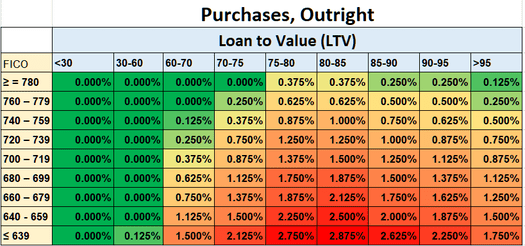
Last week, we talked about how the new mortgage pricing rules can increase costs for borrowers with higher credit and reduce them for borrowers with lower qualified credit. While the biggest impacts might be felt on borrowers that refinance for pulling cash, there will be impact on many borrowers making a purchase.
Here's the general chart of activity:
Note: this only impacts Freddie Mac and Fannie Mae-backed loans, which account for about 60% of new mortgages in the U.S.
As I mentioned last week, you still get a better loan and rate with higher credit. The advantage may be smaller - depending on circumstances - but you're still better off with better credit.
So.....this this setting us for another mortgage market collapse?
No. Not unto itself, at least. Here are three problems with the mortgage market leading up to the Great Recession that don't exist now and aren't touched by the new pricing rules above:
- In the run-up to 2008, the minimum credit score needed to secure a mortgage was reduced, allowing more people to get a loan. These riskier loans were offered at higher rates, often with sub-prime loan products. A higher percentage of these defaulted, causing many problems. The new rules do nothing to impact credit score requirements.
- Back then, the allowable debt-to-income (DTI) ratio was higher, meaning a borrower could owe a higher portion of their monthly payment to debts, such as mortgage, car loans and credit cards. That was also risky and caused a lot of problems. The new pricing rules do nothing to raise the DTI ratio to pre-recession levels.
- Prior to the collapse, some loans allowed little or no documentation to prove you had the income and assets you said you did on your mortgage application. Crazy as it sounds, you could just "promise" you had the money and maybe get a mortgage. The new policy also does not reinstate this activity.